



















Delavan AIRO™ Internal-Mix Air Atomizing Nozzles: Engineered for Low-Pressure Atomization of High-Viscosity Heavy Fuels
Delavan AIRO™ Internal-Mix Air Atomizing Nozzles are heavy-duty, two-fluid industrial components engineered to deliver high-efficiency thermal atomization for variable-viscosity fuels, including Light (#2), Medium (#4), and preheated Heavy (#5 and #6) fuel oils. Utilizing an advanced pneumatic architecture, the series uses the kinetic energy of a low-pressure compressed air stream—rather than high hydraulic line pressure—to break apart fluid boundaries and ensure a clean, stable burn. The AIRO™ series provides combustion and plant engineers with a highly reliable, modifiable oil-firing solution that handles heavy, high-SSU residual fuels down to low-volume flow rates without the risk of carbon buildup or clogging.
Delavan AIRO™ Internal-Mix Air Atomizing Nozzles: How they Work
Internal Mixing Emulsion Geometry
Unlike external-mix configurations, the AIRO™ series manages separate gas and liquid paths independently up to the final discharge stage, leveraging a specialized internal emulsion chamber to maximize atomization efficiency:
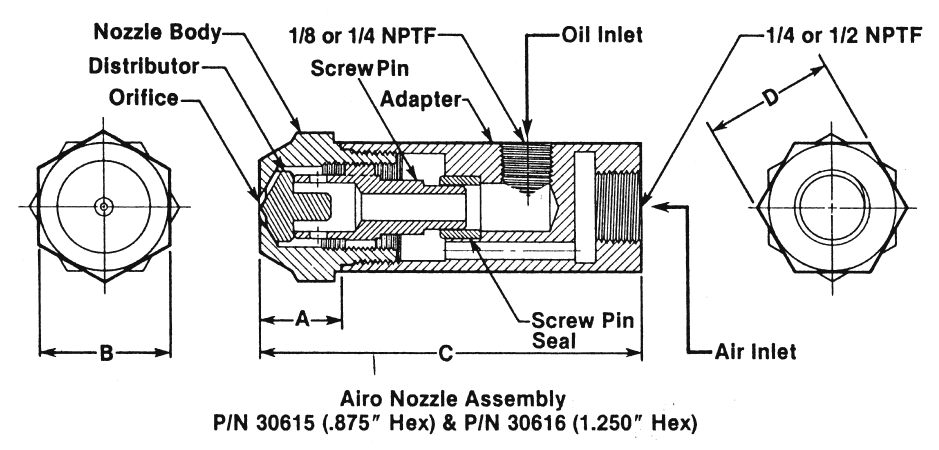
Coaxial Fluid Routing: Compressed air and fuel oil are piped independently into the nozzle body through isolated inlet ports. The fluids remain entirely separated as they pass through the internal distributor assembly to prevent premature line backpressure.
Internal Swirl Chamber Mixing: The oil and pressurized air lines intersect inside a centralized internal swirl chamber. The high-velocity air stream thoroughly churns and breaks down the thick fuel boundary layers, creating a highly volatile, pre-mixed fluid emulsion.
Pneumatic Shearing & Discharge: Rather than forcing fluid through a restrictive hydraulic orifice, the kinetic energy of the expanding compressed air shears the fuel emulsion as it exits the discharge slots. This produces an exceptionally fine droplet spectrum and complete particle shattering, allowing heavy, viscous fuels to achieve complete, smoke-free combustion.
Key Features & Benefits
Heavy Residual Fuel Compatibility: While the AIRO™ Nozzle handles light fuels across standard flow ranges from 2 GPH and up (proper nozzle must be selected for each range), the technology is explicitly designed to handle #5 or #6 oil preheated to approximately 100 SSU. Above 20 GPH, higher viscosities can also be efficiently atomized provided sufficient air volume is available.
Low hydraulic Line Pressure: Because the energy required for fluid breakup is derived from compressed air velocity, the system achieves maximum atomization using minimal fuel oil supply pressure.
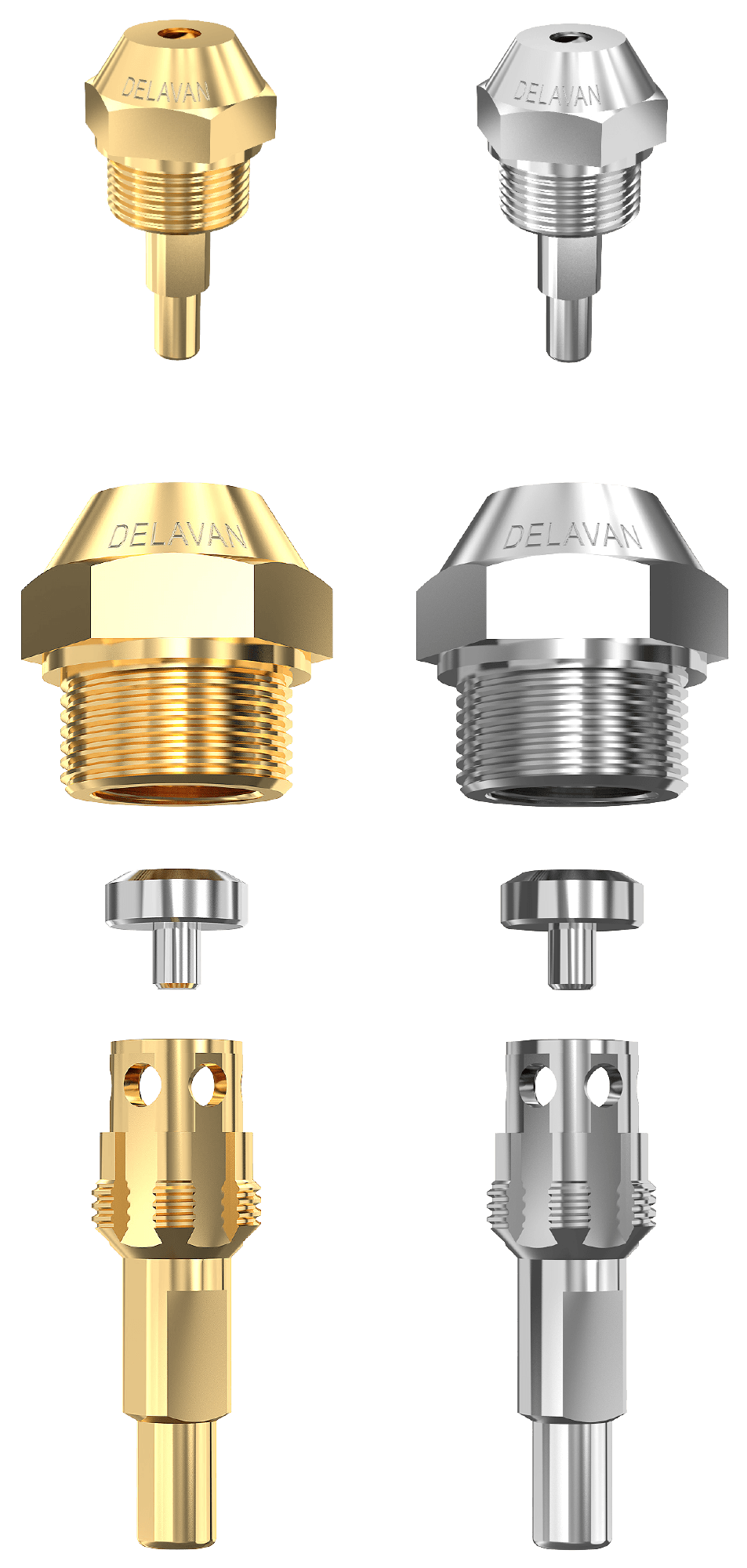
Anti-Clogging Three-Part Design: Manufactured as a robust, industrial-grade assembly consisting of three core parts (Nozzle Body, Distributor, and Screw Pin) featuring wide internal passages to eliminate particulate plugging.
Versatile Control System Integration: Offers total architectural flexibility to adapt to any control strategy — it may be deployed as a fixed discharge nozzle, arranged for two-stage (high/low) firing applications, or configured for complete modulating control over the desired flow range.
Heavy Industrial Metallurgy: Available in both robust Brass and 303 Stainless Steel configurations to withstand the extreme ambient temperatures and corrosive environments of industrial combustion chambers.
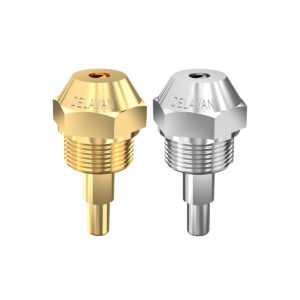
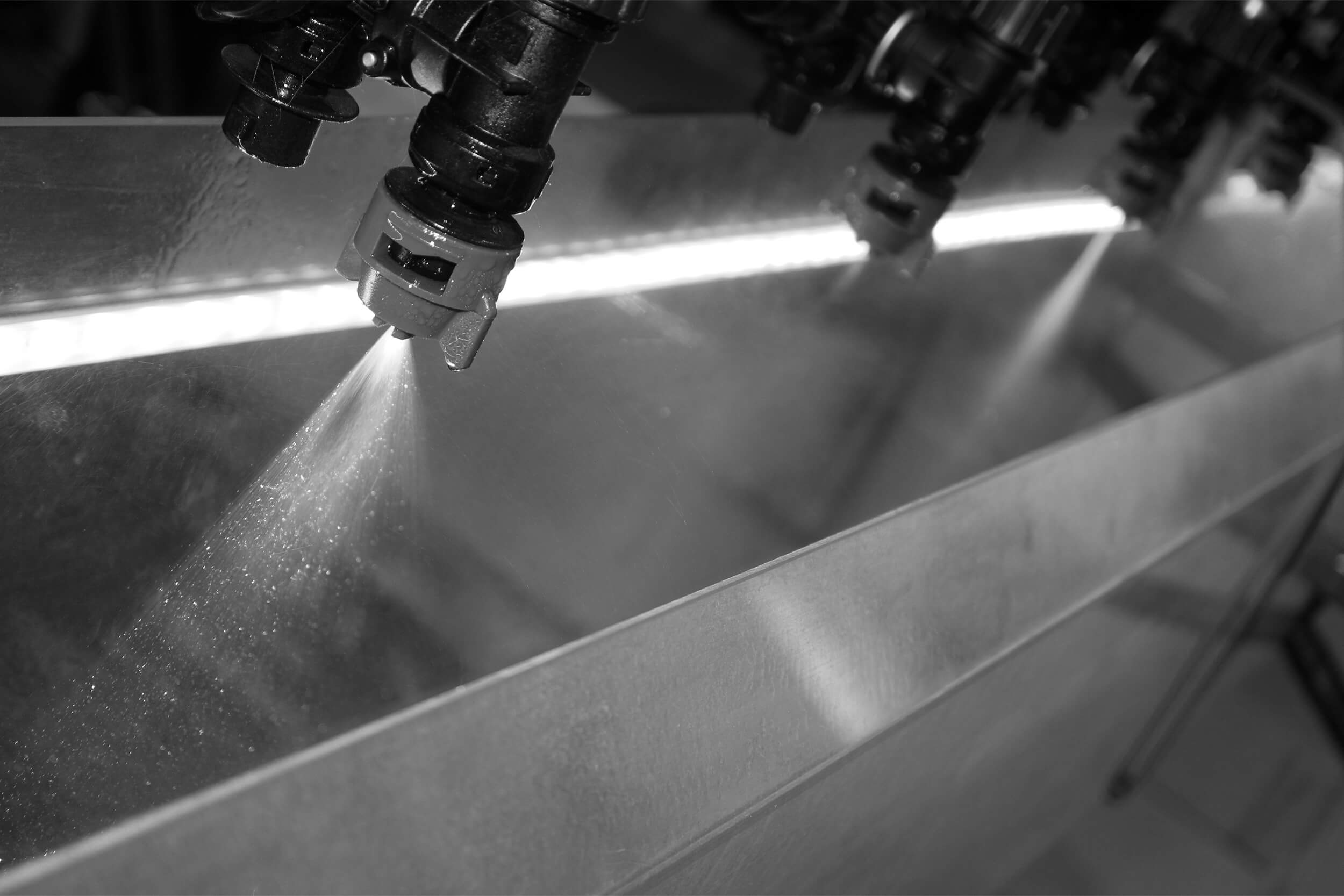
AIRO™ Air Atomizing Nozzle features a uniform solid cone spray pattern with flow rates from 10.0 to 200 GPH and spray angles from 60° to 90°.
 Solid Cone
Spray Characteristics & Fluid Dynamics
The AIRO™ internal-mixing pneumatic architecture establishes complex, interdependent fluid dynamic behaviors where spray geometry and droplet distribution scale actively with system air pressure and fuel flow rates:
Uniform Solid Cone Geometry: Projects a dense, homogenous solid cone pattern designed to guarantee a highly symmetrical and complete fuel-to-air mixing envelope.
Pressure-Dependent Angle Shifts: The spray angle is not fixed; it varies dynamically with air pressure and fluid flow. Higher compressed air pressure drives a narrower spray angle by intensifying the axial velocity component. Conversely, if a system design demands a constant spray angle across a variable firing span, a constant spray angle may be achieved by continuously modulating air pressure in parallel with fluid flow changes.
Fuel-Air Ratio Interdependency: Because the AIRO™ utilizes an internal-mixing chamber, the discharge spray angle fluctuates in direct relation to the mass fuel-air ratio (expressed as pounds of fuel per pound of atomizing air). The spray angle widens significantly at higher fuel-air ratios. For example, a baseline spray angle of 75° at a 30-to-1 fuel-air ratio will compress down to a 60° angle if the ratio is reduced to 10-to-1.
Droplet Size Optimization: Droplet distribution and mean particle diameters are heavily dependent on pneumatic energy thresholds. Droplet size is significantly smaller at higher air pressures and corresponding narrower spray angles, allowing for an increased surface-area-to-volume ratio during high-demand firings.
Anti-Clogging Geometry: The internal geometry is engineered with exceptionally large flow passages, which heavily mitigates fluid shear restrictions and drastically reduces the potential for particulate clogging or carbon face-bearding.
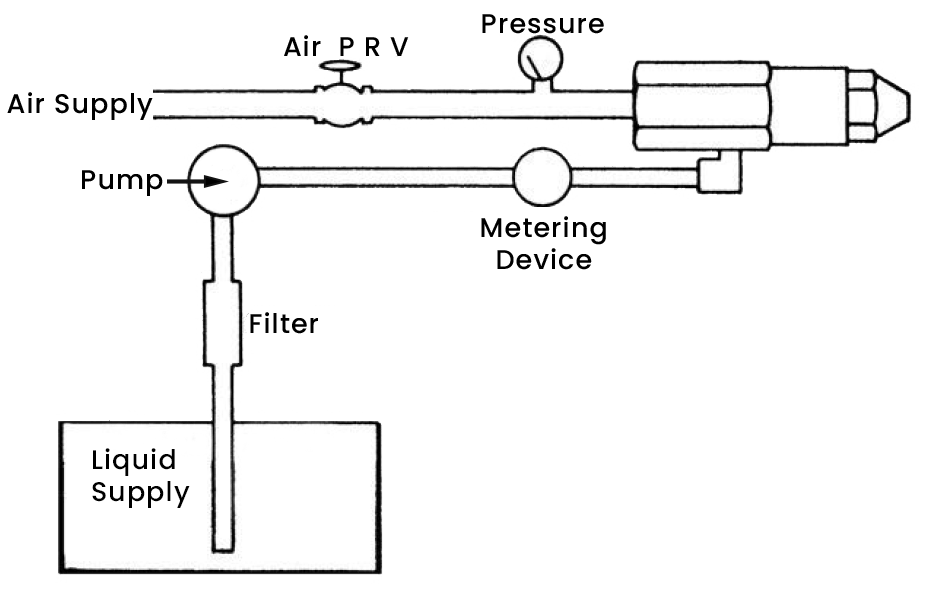
External Metering Requirement: The AIRO™ nozzle body does not possess an internal flow restriction for fluid metering. To control capacity accurately, a separate external metering device—such as a calibrated orifice, a positive-displacement metering pump, or a modulating control valve—is strictly required upstream in the fuel delivery loop.
Latest News
Keep up to date with the latest news from partners, events, our company and the wider industry.
Request a Consultation
Have questions about our spray-nozzles or fluid handling systems? Looking for help on a unique application? Need help with a budget estimate to determine overall equipment costs? Please don’t hesitate to reach out — we’d love to help.